 Ffexchange
 order tracking follows a swap from deposit to payout
Last updated -
Ffexchange order tracking follows a FixedFloat swap through deposit receipt, network confirmations, exchange, and payout. The order page updates its status, offers optional email notifications, and adds explorer links when transactions enter the network. Read the latest stage alongside the transaction details: a recognized deposit can still await confirmations, while a payout transaction belongs to the receiving side of the swap.
Jump to a section
A transaction hash identifies one blockchain transaction; the order ID identifies the exchange connecting the deposit and payout. Keeping those records separate helps explain whether the next step is waiting for confirmations, choosing an order action, or contacting support.
Fixed and floating orders follow different clocks
Choosing fixed or floating pricing changes both the deposit deadline and the point when pricing becomes final. FixedFloat’s Terms of Service, updated October 2, 2026, distinguish those events. For a fixed order, the service must receive the exact specified payment amount. Sending-side network and withdrawal fees mustn’t reduce that amount. The transaction must enter the network’s mempool or a block within 10 minutes of order creation. The market rate mustn’t change by more than 1.2% between order creation and the transaction’s appearance in the mempool. The 10-minute condition concerns network appearance; confirmations can accumulate after that window.
Floating orders leave the receiving amount open to market changes. Their rate becomes final within 10 minutes after the deposit reaches its required confirmation count. That’s a pricing window following confirmation, not a deadline for the receiving wallet to show funds. Without an arriving transaction, fixed orders expire after 10 minutes and floating orders after 30 minutes. A payment awaiting confirmations and an expired order therefore call for different interpretations.
Order IDs and transaction hashes identify different records
The order ID identifies the swap record, while deposit and payout hashes identify its separate blockchain transactions. An order link also contains receiving-address information, so retain the complete link. In the version 2 API, authenticated requests use the order ID and order security token to retrieve updated details. The token is an access credential; it doesn’t prove completion. Keep it private when sharing a transaction hash for troubleshooting. The transaction’s asset, network, and destination establish which side of the exchange it belongs to.
What does each order status mean?
Each status identifies the exchange’s current processing stage or a condition requiring attention. The version 2 status names distinguish a recognized deposit from an exchange in progress and a completed order. Read the label together with the relevant transaction record, because the same order connects an incoming payment with a separate outgoing payment.
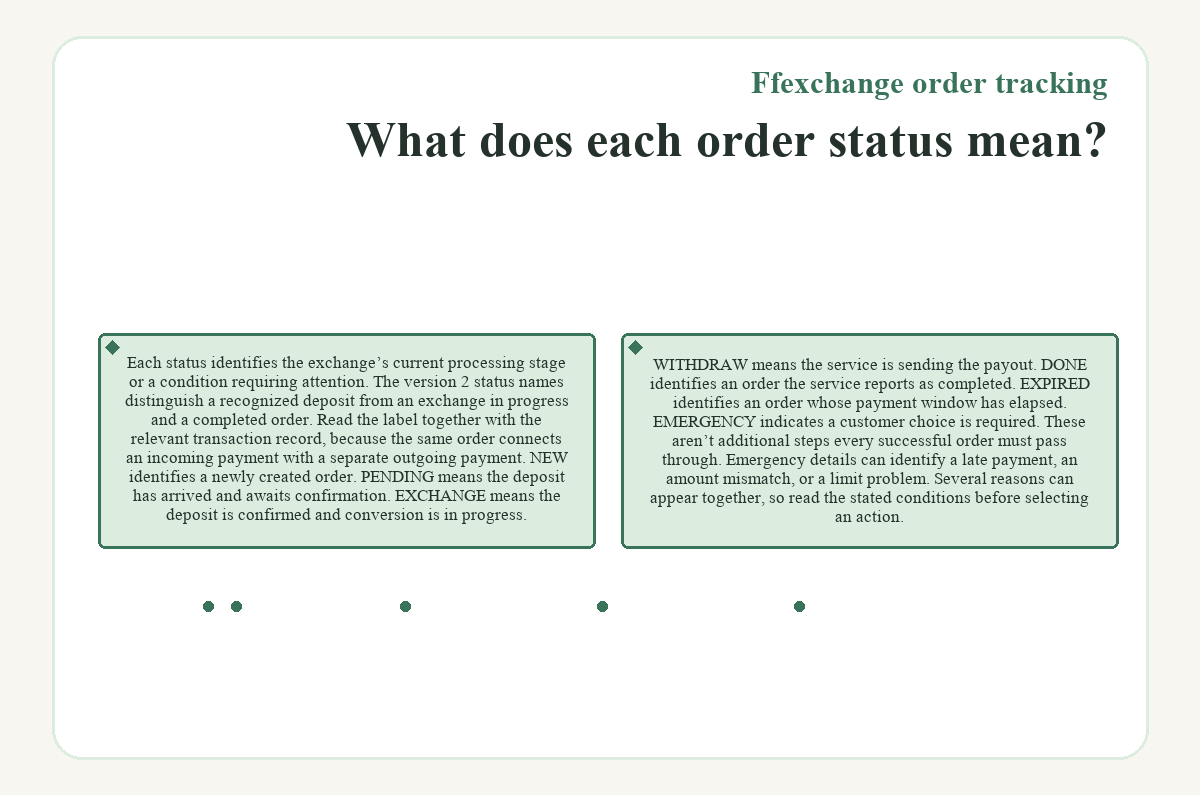
- NEW identifies a newly created order.
- PENDING means the deposit has arrived and awaits confirmation.
- EXCHANGE means the deposit is confirmed and conversion is in progress.
- WITHDRAW means the service is sending the payout.
- DONE identifies an order the service reports as completed.
EXPIRED identifies an order whose payment window has elapsed. EMERGENCY indicates a customer choice is required. These aren’t additional steps every successful order must pass through. Emergency details can identify a late payment, an amount mismatch, or a limit problem. Several reasons can appear together, so read the stated conditions before selecting an action.
Confirmations explain a pending deposit
A pending deposit has reached the service’s address but hasn’t yet satisfied the confirmation requirement needed for automatic exchange. The required confirmation count varies by cryptocurrency and can change under the service’s rules. In version 2 order data, reqConfirmations gives that requirement and the incoming transaction’s confirmations field reports its recorded progress. A blockchain explorer follows the transaction itself. Neither a transaction hash nor its first network appearance establishes that the order has met its confirmation threshold.
Network congestion, block production, and the fee attached to the sending transaction affect confirmation time. A low fee can leave a payment waiting longer. Compare the actual count with the order’s requirement instead of applying a familiar threshold from another asset. Once the required confirmations arrive, ordinary automatic processing can proceed. A separate payment-rule or compliance hold still requires its own resolution.
Match the payout record to the receiving wallet
The payout transaction describes funds sent toward the receiving address, separately from the deposit transaction used to pay for the exchange. The order page supplies its explorer link when the outgoing transaction enters the network. Match the destination and network with the receiving wallet’s details, then inspect the outgoing transaction’s confirmation state. DONE reports service-side completion; the payout record supplies the blockchain detail for checking that report. A confirmed incoming deposit alone doesn’t establish that the outgoing transfer has arrived.
An expired order has a separate recovery choice
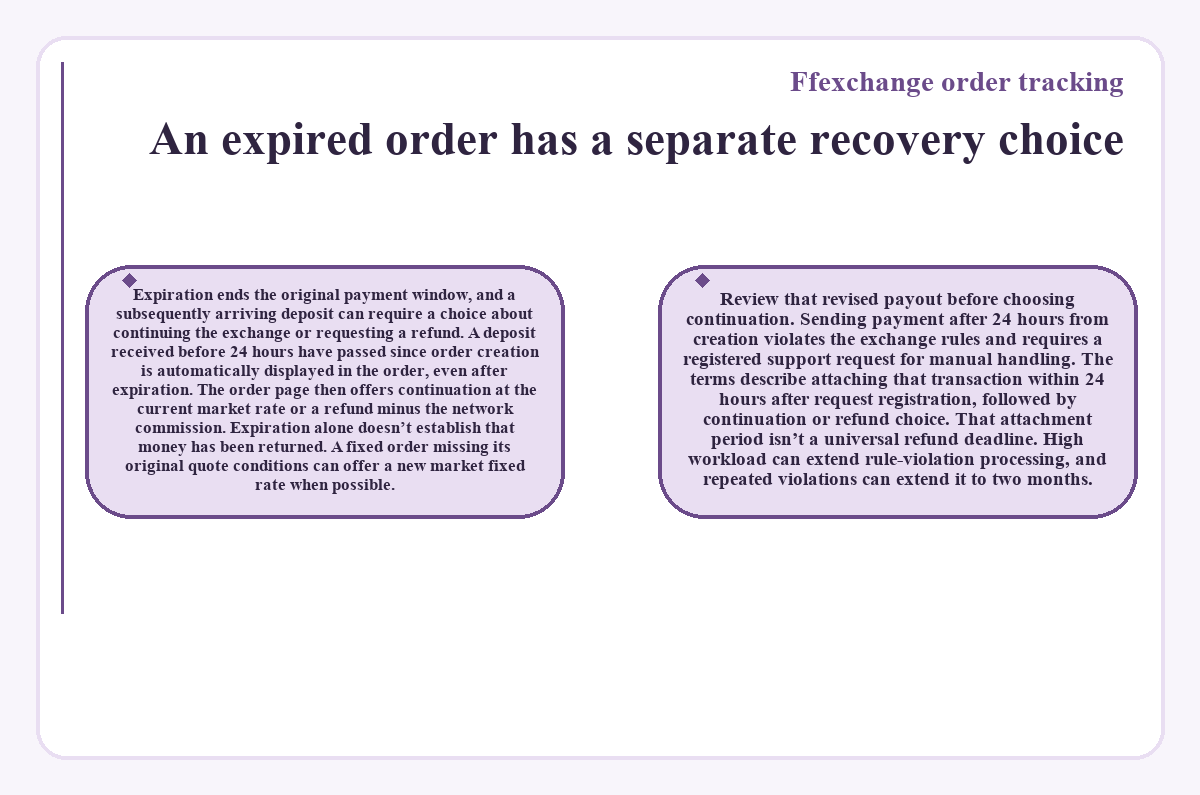
Expiration ends the original payment window, and a subsequently arriving deposit can require a choice about continuing the exchange or requesting a refund. A deposit received before 24 hours have passed since order creation is automatically displayed in the order, even after expiration. The order page then offers continuation at the current market rate or a refund minus the network commission. Expiration alone doesn’t establish that money has been returned.
A fixed order missing its original quote conditions can offer a new market fixed rate when possible. Review that revised payout before choosing continuation.
Sending payment after 24 hours from creation violates the exchange rules and requires a registered support request for manual handling. The terms describe attaching that transaction within 24 hours after request registration, followed by continuation or refund choice. That attachment period isn’t a universal refund deadline. High workload can extend rule-violation processing, and repeated violations can extend it to two months.
Keep the records support needs to identify the order
A support search requires the exchange direction, the transaction used to send funds, and the receiving address entered when the order was created. Preserve the order ID and service deposit address too, especially when reporting a payment-rule violation. The sending transaction identifies the payment under investigation; the receiving address identifies the intended payout. An incomplete record can prevent support from locating or processing the order.
For orders created on the service’s website or through its Telegram bot, payment-rule communications must come from the sender. Use the email attached to the order when the process requires it. That address must remain accessible and can’t be changed under the stated contact rules. A third party possessing a screenshot or transaction hash doesn’t automatically gain authority to request changes. Partner-created orders have a separate communication route.
Can I change the receiving address while an order is pending?
An address-change suspension requires either a notification email supplied at order creation or creation through a registered account. The service can still refuse the request.
In this hypothetical case, a pending order has an incorrect receiving address and no notification email supplied at creation. The question is whether it was created through a registered account. That missing detail determines whether the documented suspension route is available.
The saved creation record confirms the order came from the reader’s registered account. This satisfies the alternative prerequisite despite the missing order email. The reader can request suspension and describe the necessary correction by email. If neither prerequisite existed, the documented address-change route wouldn’t be available.
Suppose support suspends this order and receives the request from the reader’s account email. The stated consideration period is 24 hours after both suspension and receipt of that email. It concerns reviewing the request; it doesn’t promise a changed address or completed payout within that period.
The order now awaits a change decision, with the original receiving address still listed. Check the updated receiving-address field before treating a correction as effective.
Payment mismatches need the applicable manual handling
Sending the ordered currency on the wrong network needs different handling depending on whether the service supports that network. For supported-network cases, the terms specify processing within seven days after request registration. You can continue at the rate in effect when the transaction is attached to the order or request a refund. Unsupported-network cases have a stated 30-day processing period and permit only a refund request for amounts exceeding USD 20. Those periods remain subject to the terms’ workload and repeated-violation extensions.
For an unsupported network, recovery also requires a USD 10-equivalent processing payment in that network’s native fee currency. It must go to the order address on the original payment’s network. The full processing fee applies regardless of actual costs, and the service may refuse recovery. Wrong-currency recovery follows separate rules for the asset’s and network’s support status.
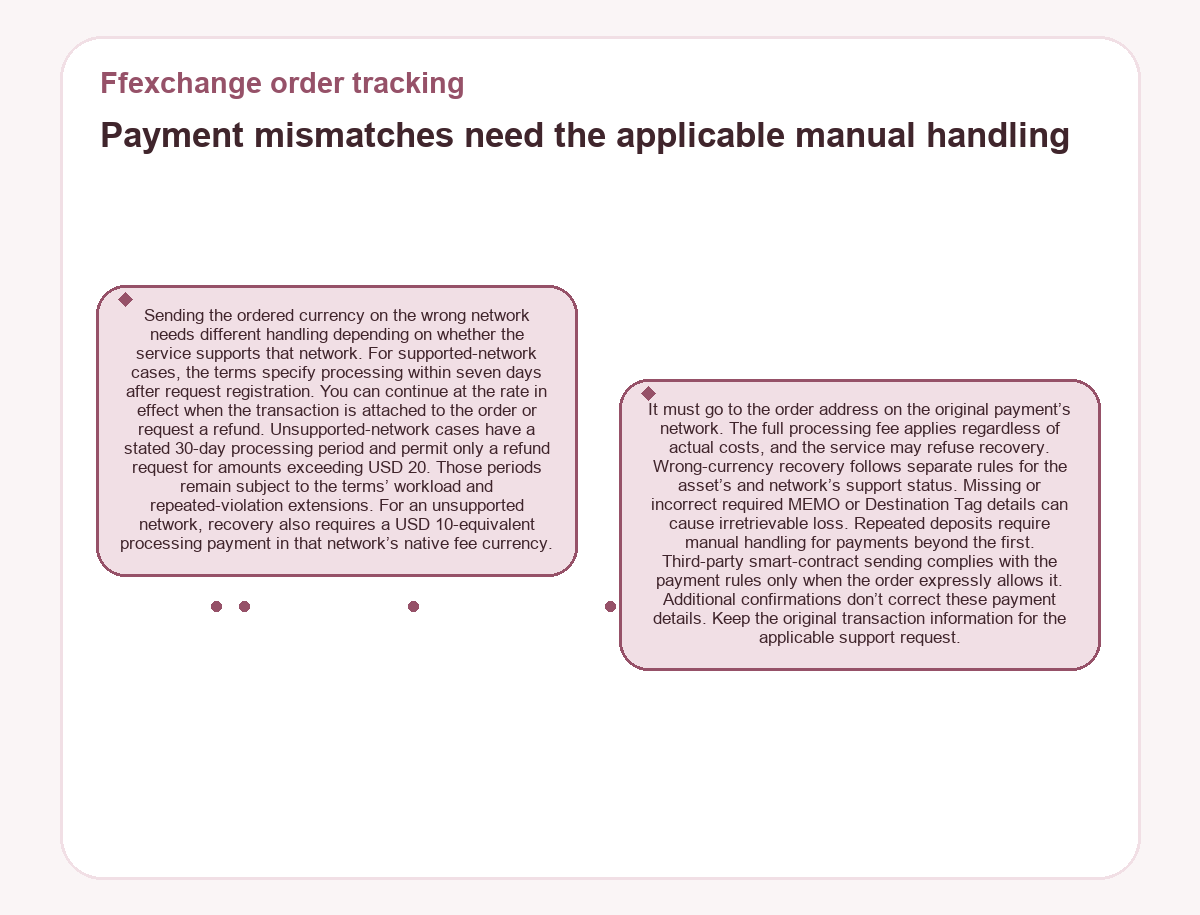
Missing or incorrect required MEMO or Destination Tag details can cause irretrievable loss. Repeated deposits require manual handling for payments beyond the first. Third-party smart-contract sending complies with the payment rules only when the order expressly allows it. Additional confirmations don’t correct these payment details. Keep the original transaction information for the applicable support request.
A compliance hold changes the next step
An order suspended for origin-of-funds information needs a response to that request, even if its deposit already has sufficient blockchain confirmations. FixedFloat may suspend an order when the funds sent are clearly related to criminal activity. This is separate from the ordinary PENDING confirmation state. The sender must subscribe to the order and conduct the required correspondence by email, using the address specified on the order.
The requested information concerns the funds’ origin and must come directly from their sender. Exceptional cases can require identity verification; refunds through that route follow verification and go only to the original sending address. Read the specific request before submitting origin-of-funds records, and use the email address attached to that order.
Helpful answers about Ffexchange order tracking
Which timestamps distinguish deposit receipt from order completion?
Version 2 order details separate the deposit-receipt timestamp from the order-completion timestamp. The time.start field records transaction receipt, while time.finish records order completion. The time.reg and time.update fields describe creation and the latest update. A recent update doesn’t establish completion by itself; interpret the timestamp with the status and the relevant transaction record.
Where can I find a refund transaction in the order data?
Version 2 order details place returned-funds information in the back object. Its tx object contains the refund transaction’s hash, amount, fee, and confirmation data when available. The to object concerns the exchange payout, so it serves a different purpose. A selected refund action alone doesn’t supply blockchain evidence of a return; inspect the returned transaction record.
Does creating another order in the same direction fix a stalled exchange?
The rules prohibit creating and paying for another order in the same exchange direction until the earlier order fully completes. A fresh order isn’t a permitted workaround for an unfinished swap. Continue investigating the original order through its own status, transaction details, and any requested action.
Can a partner representative handle a payment-rule investigation?
A partner representative or the sender can communicate with support when a partner-created order violates the exchange rules. If fraud is suspected, the partner handles verification and the decision, while processing remains suspended pending its conclusion and recommendations. Orders created on the service’s website or through its Telegram bot follow the sender-only communication rule.
Is an over-limit refund always sent to the order’s payout address?
A manual refund for an over-limit payment goes only to the original sending address when the automatic refund failed for technical reasons. This rule applies when the payment exceeds both the order amount and the maximum limit. It doesn’t authorize substituting the swap’s payout address. Contact FixedFloat support to register the manual refund request.